
Trace Jasper County Former Owners
Building the chain backward means reading the most recent conveyance first. Then you follow each grantor into an earlier deed. Jasper County Recorder materials carry most of that trail. Maps and local-history sources bridge the gaps. They help when addresses, plat names, and parcel numbering change across decades. The main Recorder page sets its public deed back index at January 1, 1884. Tapestry tells a different story. It back-indexes deeds only to 1896, so treat the two dates as separate published claims. Confirm the right one with the Recorder for the parcel at issue.
| Ownership source | Published span | Access point | Best use |
|---|---|---|---|
| Recorder deed back index | Main page: 1884 forward | Recorder terminals, Tapestry, Laredo | Grantor, grantee, date, deed reference |
| Laredo recorded records | 1963 forward | Account-based online access | Recorded information and images |
| Jasper Tract Book | 1838 to 1870 | Indiana State Library | Early tract, section, range, acreage, parties |
| Historic maps and plats | 1876 and later named runs | Recorder, State Library, map collections | Town plan, lot, block, addition, landowner clues |
Begin with the newest deed. It fixes the legal description. It also names the grantee for the next step. That name anchors the reverse search through Jasper County property records, whatever era you are studying. The Jasper County Recorder page offers a public terminal, Tapestry, or Laredo; the Laredo description covers images back to 1963, while the Tapestry service suits occasional paid searches.
Start With Jasper's Latest Deed
Think of the current parcel card as a locator, not an ownership history. Copy down the APN, situs address, owner name, and legal-description text. Find the newest deed naming that owner as grantee. Its grantor is your next former owner. A trust, estate, life estate, transfer-on-death deed, or business entity can appear where you expected a person. It might be a business entity instead. It can appear where you expected a person.
Keep a running log. Record each instrument number, recording date, deed type, parties, legal description, and book or page. The description is the continuity test. Two people sharing a name prove nothing, and one owner may have held several Jasper County parcels. One owner may have held several Jasper County parcels.
Note: A new street address or parcel number does not break a chain when the recorded legal description remains consistent.
Jasper Deed Index Cutoff
Two starting dates compete here. The Recorder's main page publishes a deed back index beginning January 1, 1884. Mortgages there start January 1, 1963. Tapestry's county page says deeds go back only to 1896. Parcel-number searching on that side begins in 2000. Those claims are not interchangeable. A near-cutoff search belongs at the office, not in a missing-transfer guess. The office posts weekday hours for public terminals.
Tapestry sells occasional-use access with images included, plus a printing cost. Laredo runs around the clock on accounts and refers subscription pricing to the Recorder. Mail and phone still work. An Indiana Access to Public Records Act request is another path. Use it when no portal or index answers the question.
Index limit. Jasper County's published online and back-index dates differ by service. Confirm an apparent gap with the Recorder before concluding that no deed exists.
Read Jasper's Deed Chain Backward
Reverse searching makes each seller the subject of the next query. Never leap from one surname to the same surname elsewhere. Match the property text at every step in Jasper County deed records. Note conveyances that transferred only part of the tract.
- Find the current owner's acquisition deed, with that owner listed as grantee.
- Copy the grantor name, instrument date, deed type, and full property description.
- Search that grantor as an earlier grantee and compare the land description.
- Repeat until the index ends, then move the verified reference into deed books or microfilm.
- Grantor
- The party conveying an interest in the deed.
- Grantee
- The party receiving the interest.
- Chain of title
- The ordered sequence of conveyances tied to the same land.
- Reverse index
- An index organized to find the conveying party.
- Warranty and quitclaim
- Different deed forms. Neither name alone proves what interest passed without reading the instrument.
Estate Transfers in Jasper Records
The buyer-to-seller rhythm can stall when an owner dies. Executor or administrator deeds, transfer-on-death deeds, life estates, survivorship language, and probate orders may explain the next name. Search the Recorder first for the land instrument. Then turn to Indiana MyCase for a nonconfidential estate case, with the Jasper County Clerk holding the official file.
Probate evidence still needs a parcel. An obituary can explain a name change. It is not a conveyance. Reconnect the chain with the legal description, court cause number, deed reference, and recording date.
Jasper Plats Preserve Old Places
Old deeds rarely use today's street address. A Jasper County legal description may cite a subdivision, lot and block, township and section, or metes and bounds. Recorded plats and the Recorder's subdivision-code resource translate them. The Indiana State Library Jasper map catalog lists maps and plat books from 1902 through 2015, including the 1909 Standard Atlas and later owner-indexed volumes.
A plat is a recorded drawing. It divides land into lots, blocks, streets, and easements. The same lot can wear two different street wordings across deeds, and a plat proves it. Pair each plat reference with the deeds and the current parcel, since a plat alone cannot list every later conveyance.
From Jasper Tracts to Parcels
Jasper County dates to 1835. A State Library Tract Book spans 1838 to 1870. It reaches behind the modern APN system. Copy each tract, township, section, range, acreage, grantor, grantee, and date. Follow the deed-book references forward until they meet the chain built backward.
The bridge matters most where the trail ends before the 1884 Recorder back index. Fallback channels include State Library microfilm. FamilySearch is available at the Jasper County Public Library. Recorder terminals and county historical holdings also help. The 1890 federal census is missing. Land, marriage, newspaper, obituary, map, and directory clues may carry a name between census years.
Library Clues for Previous Owners
The Jasper County Public Library genealogy collection is a quiet workhorse for tracing old ownership. It holds obituary indexes, census indexes, and newspaper microfilm. Cemetery resources and the 1909 Standard Atlas index sit alongside FamilySearch access. Together they can tie a person to a road, a farm, a town block, an estate, or a sale notice. That link often comes before any deed reference is known, which makes the library a natural first stop for older Jasper County ownership clues.
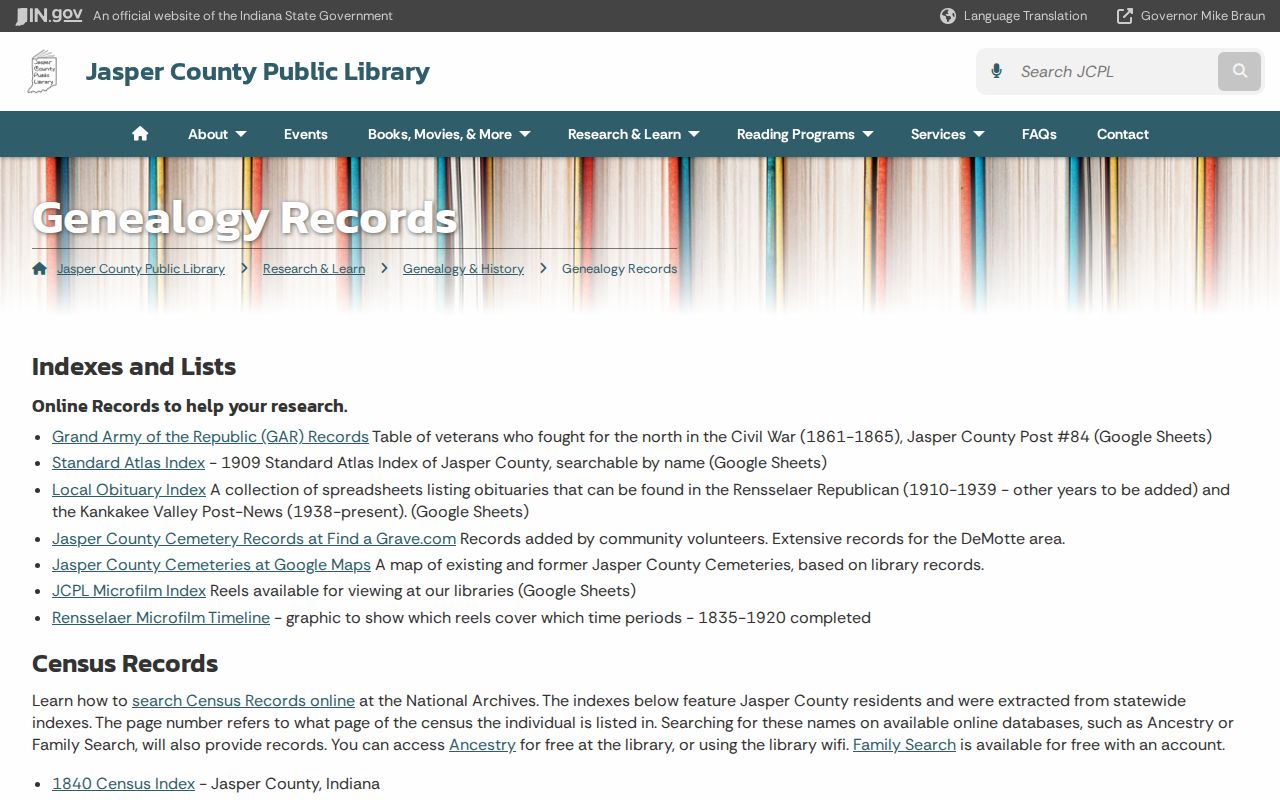
The library's collection page is the access point for these name-and-place sources. Every lead still needs a deed to back it up. Rensselaer offers an especially useful 1933 special census. It also holds long newspaper runs. Treat each find as a pointer, not proof. An atlas entry or obituary narrows the period and place. It shows where a former owner lived. The Recorder's recorded instrument remains the evidence of who actually held title.
Note: Search DeMotte as both “DeMotte” and “De Motte,” and search historic Remington material under “Carpenter Station” and “Carpenter.”
Verify Each Jasper Prior Owner
A reliable timeline records what each source actually says, nothing more. Watch the deed date closely. The recording date can differ from it. A tax record names the assessed owner for a year yet proves nothing about the exact day title changed. Maps print landowner names but often omit later transfers. Mark every uncertain step in the chain. Then return to the recorded instrument. Lot splits, combinations, annexation, and new parcel identifiers demand extra care. Track parent and child descriptions, not just parcel numbers. When a chain branches, list each conveyed part separately. Reunite only those pieces the later deed or plat actually combines.
How Far Jasper Ownership Goes
The online trail has a published cutoff. Jasper County land history reaches farther through deed books, and through the 1838 to 1870 Tract Book, recorded plats, and State Library microfilm. Not every older image is online. A negative web result means the access channel ended. It does not mean the ownership event never occurred. Research into former owners supports house history, estate work, purchase diligence, and title preparation. Legal rights may depend on the answer. Certified copies, a survey, or professional title work may be needed then.
Lawful use. Jasper County prior-owner records are for legitimate property and history research. Never use personal information to stalk, threaten, or harass anyone.